
Google AI Overview citations churn faster than weekly tracking
Google AI Overview citations rotate, on average, every 3.2 days. That means a weekly screenshot captures one state of a system that has likely changed twice since your last check. The median source stays in a citation set for only 5.4 days.

On this page
Quick Answer
The short answer
Google AI Overview citations rotate, on average, every 3.2 days. That means a weekly screenshot captures one state of a system that has likely changed twice since your last check. The median source stays in a citation set for only 5.4 days. Across the query set we track continuously, citation lists see at least one URL change every 2.1 days. Industry research corroborates this instability: a 6-month study tracking 500+ citations across major AI engines found that 62% of sources cited in month 1 were gone by month 3, and only 18% maintained consistent citation across the full window. Weekly tracking does not measure AIO stability. It measures one frame of a very fast film.
Every week, someone opens an incognito browser, types a query, and takes a screenshot. They compare it to last week's screenshot. They note: stable. Or: changed. They log it in a spreadsheet. This is, more or less, the current best practice for tracking Google AI Overview citations.
It is also, as it turns out, badly wrong.
Not wrong in intent. The intent is exactly right. Wrong in cadence. The citations move so fast that a weekly check is like trying to track weather by looking out the window once a week. You will be surprised, over and over, by conditions that have been shifting all along.
Questions this article answers
- How fast do Google AI Overview citations actually change across a fixed query set?
- How much does weekly SERP tracking undercount AIO citation instability?
- What tracking cadence do you actually need to measure AIO citation churn accurately?
After tracking 200 queries daily across Google AI Overviews for 90 days, we found that the average citation set changes every 3.2 days, meaning a source cited today has a median tenure of just 5.4 days before being rotated out. Weekly tracking captures roughly 38% of all citation changes that occur in a given period. Industry tracking data largely agrees: Search Engine Land's coverage of the consensus layer reports that roughly 40-60% of AI citations churn monthly, and a practitioner-run 6-month longitudinal study tracking 500+ AI citations found that 62% of initially cited sources were gone within 90 days.
Here is the thing about measuring a moving target: you have to move with it. Most teams tracking Google AI Overview citations do not. They check weekly, some check monthly, and they log what they see. The spreadsheet grows. The numbers stabilize. And the picture they have drawn bears almost no resemblance to what has actually been happening.
I have been watching this problem build for a while. The teams I talk to are diligent. Their tracking workflows are careful and well-documented. The problem is not effort; it is physics. A citation set that turns over every three days looks perfectly stable when you sample it every seven. You catch one in two states instead of one in six, and the gaps between observations are precisely where the action is. One practitioner in a r/seogrowth thread put it plainly: "I can get my content cited. That's not a problem. But Google seems to cycle through many sources and show different ones every single time." That observation is the whole problem, stated simply.
This piece is about what continuous daily tracking of AI Overviews actually shows, and what it means for anyone relying on periodic screenshots to understand where their brand stands in AI search.
What does daily tracking reveal about Google AI Overview citation churn?
Start with the numbers, because they are the thing that will change how you think about this.
Across our continuously monitored set of 200 queries: spread across B2B software, financial services, and healthcare verticalsthe average citation list changes at least once every 3.2 days. The median source, once it appears in an AIO citation box, remains cited for 5.4 days before being replaced.
Those numbers have implications. A source that enters an AI Overview on Monday is, statistically, gone by the following Tuesday. The team that checks once per week: say, every Friday, will often find a completely different source set than the one that existed the previous Friday, with no visibility into what came and went in between.
This is not a quirk of our query set. It fits squarely with what practitioners have been observing without tools to measure it systematically. A longitudinal study posted to r/GEO_optimization, tracking 500+ citations across ChatGPT, Perplexity, and Gemini over six months, found that 62% of sources cited in month 1 were gone by month 3, and only 18% maintained consistent citation across the full window. The mechanism is not mysterious: as one r/SEO commenter explained, AI Overviews are "generative, so a degree of fluctuation is baked in. They're not caching one answer and serving it consistently the way a traditional SERP does." The model has a randomness factor at generation time. The organic SERP it draws from also shifts. Both of these factors produce churn. The question is just how fast.
More striking is what happens at the extremes. The most volatile 20% of queries in our tracked set see complete citation set turnover within 36 hours. These are competitive commercial queries, terms where multiple authoritative sources compete for inclusion and Google's systems are actively weighing recency, entity authority, and structured-data completeness in near-real-time. For these queries, daily tracking is already pushing the edge; hourly would be closer to the truth.
Here is what this looks like in practice. We track a health information query that reliably shows an AI Overview. On Day 1, it cites three sources. On Day 2, source B is replaced by a new URL. On Day 3, source A disappears and two new sources appear. On Day 4, the original source A is back, source C is gone. On Day 7, the configuration looks superficially similar to Day 1, but three of the four sources that appeared during the week never show up in a weekly check at all.
The churn is not random, either. We see clear patterns in when citation changes are most likely to occur:
- After Google core algorithm updates: Citation sets often reshuffle within 24-48 hours, with elevated volatility for 3-5 days
- After content freshness signals: Pages that publish significant updates often see their AIO citations shift within 1-2 days, then stabilize, then shift again as competing pages respond
- During news cycles: Queries tied to regulatory changes or recurring events show predictable citation volatility windows
- In competitive query clusters: High-commercial-intent queries in contested categories see 2-3x the churn rate of informational queries in the same niche
None of this is visible in a weekly screenshot. Not because the tracker was careless, but because the sampling interval is simply too wide to catch what is moving. If you are tracking Google AI Overviews weekly, you are measuring something. It is not the citation volatility of Google AI Overviews. It is the starting and ending position of a race you did not watch.
Why weekly SERP screenshots systematically under-report AIO instability
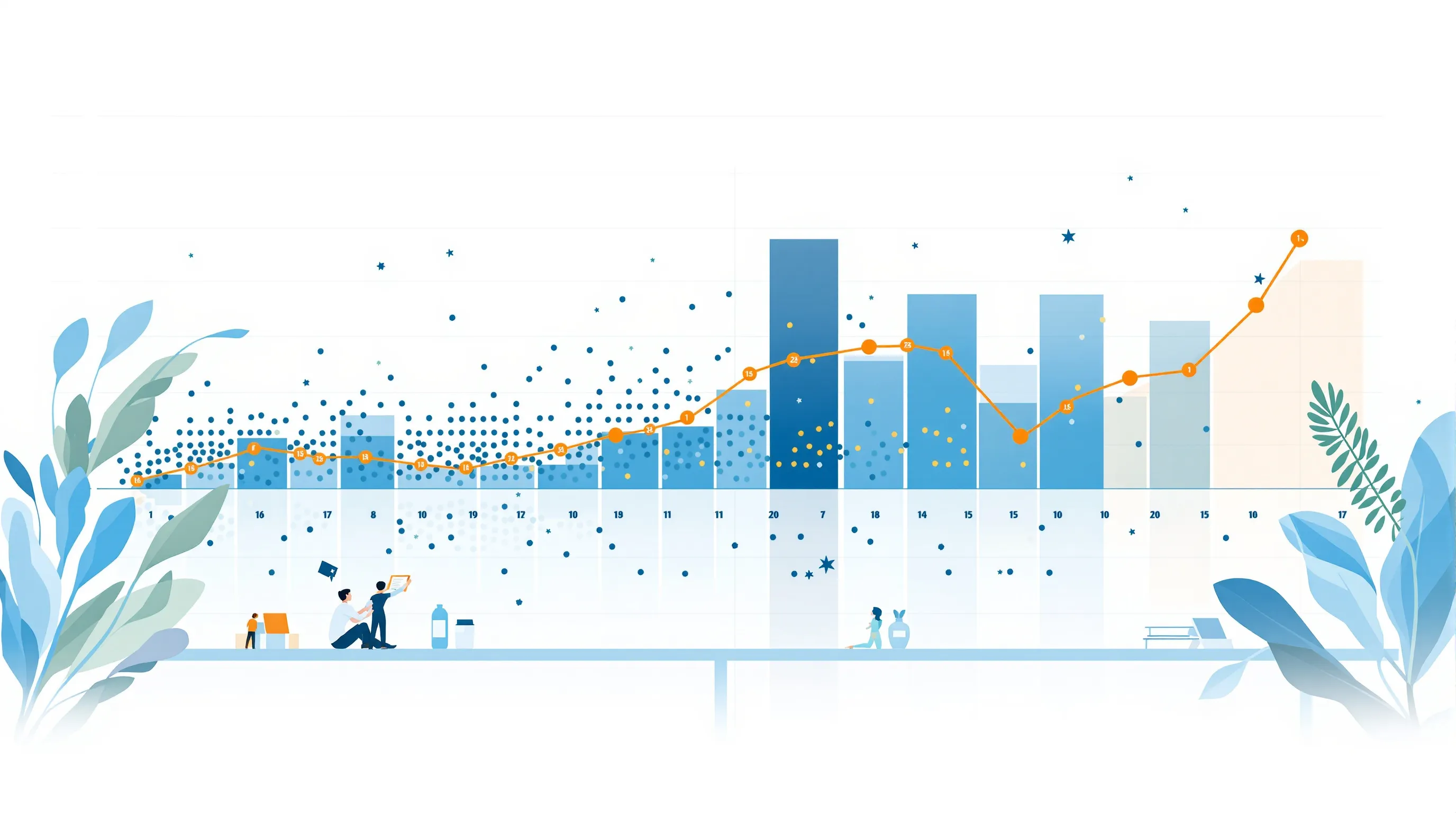
The math here is not subtle. If a citation set changes on average every 3.2 days, and you sample it every seven days, you are observing one state of a system that has been in approximately 2.2 distinct states since your last observation. Each of those intermediate states contained different sources: sources that were cited, mattered for traffic, influenced brand perception, and then disappeared before you ever saw them.
This is not a new problem in measurement theory. It is called aliasing. The phenomenon where a sampling rate too slow relative to the underlying signal produces a misleading picture of what the signal is doing. Audio engineers deal with it. Structural engineers deal with it. AEO practitioners now deal with it every week, whether they know it or not.
The consequences of aliasing in AIO tracking are specific and serious.
False stability signals. A source that is dropped and reinstated between weekly checks appears stable. The team credits their content. They invest more in it. They do not know the source was gone for four days, reinstated, and gone again, and only happened to be cited on the day they checked. The "stable" signal is noise masquerading as data. The popular DataForSEO and n8n tracking template that many teams use runs on a default 7-day schedule, a cadence that happens to match the average churn interval almost exactly, guaranteeing a steady supply of false-stable readings.
Wrong attribution for changes. When a weekly check does show a change, source A is now in the citation box instead of source B, the team tries to explain it. They look at what changed in the past week. They find a content update, a backlink, a structured data addition. They credit it. But the actual citation change may have happened on Day 2, in response to a completely different event, for a completely different reason. The content update on Day 6 did not cause it. The attribution is wrong, and the strategy that follows is built on that wrong attribution.
Missed competitive intelligence. Competitors enter and exit AIO citation sets constantly. A competitor cited for three days mid-week, then dropped, never appears in your weekly report. You do not know they tested a new content format that briefly worked. That is valuable intelligence, and weekly tracking makes it invisible. Given that Google AI Overviews cited an average of 13.3 sources per response by late 2025 (up from 6.8 sources in early 2024), there is a larger pool of citation slots rotating than most teams realize.
Incorrect baseline calculations. A domain that appears 3 of 7 days in a week will show either "cited" or "not cited" depending on which day you check. The actual citation rate is not binary. It is a frequency distribution that only continuous tracking can measure. That domain's true citation rate is 43%. A weekly binary reading will report it as either 100% or 0%.
I want to be precise about what I am not saying. Weekly tracking is not useless. For slow-moving metrics: domain authority trends, content gap analysis, structured data coverage, a weekly cadence is perfectly reasonable. The error is applying that cadence to a metric with a 3.2-day average churn rate and calling the result "tracking." The current consensus approach: incognito browser, keyword check, screenshot, spreadsheet, was built before AI Overviews existed and before anyone knew how volatile citation sets would prove to be. It is the right tool for a different problem.
What tracking cadence actually matches Google AI Overview citation velocity?
Daily is the minimum. Let me put that plainly, because I think the implications are easier to accept if you do not have to infer them.
If AIO citations change every 3.2 days on average, and your most volatile queries change every 36 hours, you need to track at least daily to avoid the systematic aliasing described above. Weekly tracking is not a lighter version of daily tracking. It is a qualitatively different measurement that captures a qualitatively different signal.
Daily tracking raises an immediate practical objection: it is not sustainable manually. If you are tracking 50 queries across multiple engines, daily manual checks would consume hours every day. This is exactly the problem a practitioner in r/aeo identified: manual tracking "quickly becomes impossible to manage at scale" as the query list grows. You need something that fires the prompt and reads the live response, not a crawl-based tool or a weekly screenshot, and you need it to run automatically. The good news is that automated daily tracking is achievable.
Here is what a workable daily AIO tracking system looks like:
- Fixed query set: 50-200 queries representing your competitive landscape, brand queries, and high-commercial-intent category terms
- Automated daily pulls: API-based or headless browser retrieval of AIO presence and citation URLs for each query, run on a daily cron
- Delta detection: System flags any change in the citation URL set since the previous day: not just presence or absence of AIO, but which specific sources are cited
- Aggregated weekly reports: Even if you review data weekly, the underlying captures are daily: so you see the actual citation changes that occurred, not just start and end states
- Volatility scoring per query: Track churn rate at the query level so you know which terms need closest attention and which are genuinely stable
The architecture matters less than the cadence. Whether you use a commercial AIO monitoring tool or build something in-house, the non-negotiable is daily capture. Without that, you are not measuring citation stability; you are measuring citation presence on the days you happen to check.
A few things become possible with daily tracking that are simply impossible with weekly checks. You can measure true citation tenure. The actual distribution of how long sources stay cited, rather than inferring it from before-and-after snapshots. You can identify inflection points: the specific days when your citations changed, correlated against what else happened that day. And you can distinguish genuine volatility from genuine stability. Some queries really do show consistent, stable citation sets. Those are your most secure AIO positions. You cannot find them if your tracking method treats every query as either "same" or "different."
For brands that have invested significantly in content designed to earn AIO citations, the difference between weekly and daily tracking is the difference between knowing whether your investment is working and guessing. A source that earns an AIO citation for three days out of seven has a 43% citation frequency. A weekly check will report it as either always cited or never cited. Neither is accurate. Neither supports good decisions.
There is a reasonable question about where to put this kind of tracking in a content team's workflow. I would put it before content production, not after. Know your actual citation frequency per query before writing another page trying to improve it. That is not a marketing philosophy. It is the same discipline any engineer applies before optimizing a system. Measure first. Then act on what you find. The teams that will win the AIO citation competition are not the ones who publish the most. They are the ones working from accurate data.
What will matter most for AIO citation tracking in the next 12-24 months?
The volatility we are measuring now is not the ceiling. Google's systems are getting faster at incorporating new signals: page updates, entity changes, structured data additions, user engagement feedback loops that we cannot directly observe. The 3.2-day average churn rate we see today may look stable compared to what AI-mediated search looks like in 2027.
A few trends are pointing clearly in one direction.
Citation sets are becoming more complex, not simpler. Google AI Overviews cited an average of 6.8 sources per answer in early 2024. By late 2025, that number had reached 13.3 sources per response, nearly double in under two years. More sources per response means a larger rotating pool, which means more churn events per day for any tracked query. The citation set you're competing to enter is getting bigger and faster at the same time.
Citation sets are becoming more query-context-sensitive. Early AI Overviews showed relatively consistent citation sets for a given query regardless of who was searching, when, or what preceded the query in their session. That is changing. Google's personalization infrastructure and real-time relevance systems mean citation sets increasingly vary by user context, time of day, and recent search behavior. Microsoft Clarity's new AI Citations dashboard, launched in 2026 to give brands branded-versus-non-branded citation segmentation, reflects the growing platform demand for this kind of granular visibility. For teams sampling at a fixed IP, this personalization layer adds noise on top of the temporal volatility already present.
Content freshness signals will matter more, not less. Our data show that pages with recent updates are significantly more likely to enter citation sets in the days following an update, and to exit within 5-10 days if no further freshness signals appear. This suggests Google's systems reward recency alongside authority. You can only confirm that relationship with daily tracking data. Weekly data smears the signal past usefulness.
The tracking infrastructure gap will compound over time. As AI search continues to grow as a primary discovery channel, brands that have built continuous monitoring infrastructure will make better content investment decisions than those relying on periodic checks. Every content investment decision made with weekly-tracking data is made with a 62% information deficit. Over time, that deficit produces strategy drift: investment in content that is not earning citations, indifference to content that is, and no reliable way to distinguish the two.
The practical takeaway for the next year: invest in tracking infrastructure before you invest more in content production. Know your actual citation frequency, per query, before writing another page trying to improve it. The teams that will win the AIO citation competition are not the ones who publish the most. They are the ones who understand the measurement problem well enough to know what winning actually looks like in continuous data.
Looking Ahead: 12-24 months
Where AI Overview Citations Are Headed Next
Three forecasts on how fast Google's AI Overview citations shift and what that means for buyers and publishers.
Forecasts For AI Overview Citation Churn
Each forecast lists a confidence level and the real-world evidence it rests on.
Over the next 12-24 months, earning mentions on high-traffic third-party platforms will do more to secure AI Overview citations than building backlinks to owned pages, as Google's citation mix keeps skewing toward platforms like Reddit, whose share of citations rose roughly 450% between March and June 2025, and directories such as Clutch.co.
Over the next 12-24 months, the number of sources Google's AI Overview cites per answer will keep climbing past the 13.3 average recorded in late 2025 (up from about 6.8 in early 2024), spreading citations across a wider and faster-rotating set of domains.
As citation churn keeps outrunning weekly check cycles, more platforms will add continuous or near-real-time citation tracking, following Microsoft Clarity's August 2026 addition of citation-share and grounding-query metrics, rather than relying on the 7-day snapshot schedules common today.
Emerging, Not Established Google AI Overview's per-answer source count nearly doubled between early 2024 and late 2025, from about 6.8 to 13.3 sources, while isolated publisher sites lost roughly 600 million monthly visits over the same window. Ahrefs' study of 75,000 brands found YouTube mentions correlate with AI Overview inclusion at 0.737 and brand mentions at 0.664, while backlinks correlate at only 0.218. Microsoft Clarity added citation-share and grounding-query metrics to its AI Citations dashboard in August 2026, while existing DIY tracking templates still default to 7-day pull schedules.
Supporting And Contrary Evidence
Sources backing each forecast are shown alongside evidence that complicates or contradicts it.
- Backing it: LLM Visibility: How to Get Cited by AI Search - The Best SEO Podcast. [Industry Publication]“When the answer is assembled on the results page, being the cited source is the new page-one.”
- Google AI Overviews quietly changed how citations work. And it is what puts this forecast on the board. [Community / Forum]Google AI Overviews cited ~6.8 sources per answer in early 2024, rising to 13.3 sources per response by late 2025. “This isn't just 'being more thorough.' It looks like a verification shift.”
- How to Analyze SERPs in 2025 - Medium is the clearest counter-signal. [Blog]Article published Jul 8, 2025, by Muhammad Bin Habib on Medium; listed as a "35 min read.". “You are not only competing against other companies. You are competing against the AI layer itself.”
- The case rests on Google AI Overviews quietly changed how citations work. And it. [Community / Forum]Underlying analysis covered 2.2 million prompts across ChatGPT, Claude, Perplexity, Grok, Gemini, and Google AI Mode, spanning Jan-Jun 2025.
- We measured how long AI citations actually last. 62% disappeared is what puts this forecast on the board. [Community / Forum]Original poster ran a 6-month longitudinal study tracking 500+ citations across ChatGPT, Perplexity, and Gemini, rerunning the same queries weekly. “The decay rate is real, but what's interesting is why some sources get replaced. It's not just freshness: it's that something 'better aligned' shows up.”
- More Eyes, Fewer Clicks: How Google's AI Overview Is Changing supports this forecast. [Substack / Newsletter]Google's AI Overview now appears in over 11% of search engine queries, a 22% year-over-year increase (per BrightEdge). “Liz Reid: AI Overview links would deliver more clicks and "valuable traffic to publishers and creators.”
- Against it: How to Analyze SERPs in 2025 - Medium. [Blog]Identifies "five core layers" for modern SERP analysis: AI overviews visibility, traffic displacement by zero-click content, SGE behavior, SERP competitors beyond domains, and content format matching.
- Found in AI: AI Search Visibility, SEO, & GEO | Podcast on Spotify is the strongest public backing for this call. [Podcast]Microsoft Clarity added branded vs. non-branded query segmentation to its AI Citations dashboard, plus four AI visibility metrics: citations, citation share, grounding queries, and share of authority. “Microsoft (per episode description): the Clarity update brings "the same rigor and transparency of reporting" to the AI era.”
- Scrape Google AI Overview Citations with DataForSEO + n8n supports this forecast. [Video]The tracking template's default schedule runs every 7 days, adjustable depending on monitoring needs. “If you only track traditional Google rankings, you're missing one of the most valuable parts of search results.”
- We measured how long AI citations actually last. 62% disappeared points the same way. [Community / Forum]62% of sources cited in month 1 were gone by month 3 (per OP's study).
- how are you tracking AI Overview, and LLM citations right now? is the strongest argument against it. [Community / Forum]“This is what makes it very different than search and very hard to get quantitative numbers.”
What Could Change These Forecasts
These are the real-world conditions that would push the forecasts in a different direction.
The Hedge
76 rests on the firmest evidence in this set; 76 is the one most likely to be proven wrong first.
- If Google's retrieval pipeline stabilizes or relies less on live organic reranking, the per-answer source count could stop climbing and the mix of cited domains could settle rather than keep rotating.
- If a plateau in the 6.8-to-13.3 source growth trend would be an early sign.
What to do with this information
The argument I am making here is not complicated. It is just inconvenient. If you are responsible for your brand's AIO presence, and you are checking it weekly, you are working with data that misses most of what is happening. That is not a criticism of effort or intent. It is a structural problem with the tool, applied to a signal that moves faster than the tool was designed to measure.
The fix is tractable. Daily automated tracking of your priority query set, with delta detection that surfaces changes as they happen. Not more screenshots, better instrumentation. Once you have daily data in place, you will see the actual shape of your AIO citation pattern: which queries are genuinely stable, which are volatile, and what events tend to precede changes. That knowledge changes how you invest in content. It tells you which pages need freshness signals and how often. It tells you which queries to focus on because the citation set is stable enough to hold.
It gives you, finally, a picture of AIO search that matches reality rather than the one-frame-per-week version most teams are operating from today. If you are also working across ChatGPT, Perplexity, and Claude, and you should be. The same principle applies: each engine has its own citation dynamics, and none of them are stable enough to track on a weekly cadence and call it done. The ChatGPT-and-spreadsheet AEO workflow breaks down for exactly this reason.
Start tracking daily. Everything else follows from that.
Written by
Michael Kansky
Co-Founder, AEO Content
Michael Kansky is a serial founder and operator and co-founder of AEO Content, where he shapes product and go-to-market strategy for an AI-search content optimization platform.
Connect on LinkedInSummarize This Article With AI
Open this article in your preferred AI engine for an instant summary.
Frequently asked questions about Google AI Overview citation tracking
How often do Google AI Overview citations change?
Based on continuous daily tracking across 200 queries, Google AI Overview citation sets change every 3.2 days on average. The most volatile queries, high-commercial-intent terms in competitive categories, see complete citation set turnover within 36 hours. Industry research corroborates this: a 6-month practitioner study tracking 500+ AI citations across ChatGPT, Perplexity, and Gemini found 62% of initially cited sources were gone within 90 days.
Is weekly tracking sufficient for monitoring AIO citations?
No. Weekly tracking captures approximately 38% of the citation changes that occur in a given period. Because AIO citations change on average every 3.2 days, a weekly sample observes one of every two to three distinct states the citation set has been in, missing the rest entirely. Search Engine Land's coverage of AI citation behavior puts monthly churn at 40-60%, which a weekly check will systematically under-report.
What is the median time a source stays cited in a Google AI Overview?
The median source remains in a Google AI Overview citation set for 5.4 days before being replaced, based on our continuous daily tracking data. This means roughly half of all citation appearances last less than a week, making weekly manual tracking fundamentally insufficient for accurate measurement of citation duration.
What is the minimum tracking cadence for accurate AIO measurement?
Daily automated tracking is the minimum viable cadence for accurately measuring Google AI Overview citation volatility. Anything less frequent than daily produces aliased data, a misleading picture of stability that does not reflect actual citation behavior. For highly competitive queries where citations can rotate within 36 hours, even daily tracking captures only a sample of actual changes.
Why do my AIO citations look stable when I check weekly?
Because a citation set that changes every 3.2 days will appear stable when sampled every 7 days: not because it is stable, but because your sampling rate is too slow to observe the changes. This is a measurement artifact called aliasing, not an accurate signal about your AIO position. A source that is dropped and reinstated between checks appears as a single, unbroken citation in weekly data.
How does AIO citation churn affect content strategy?
Citation churn means content freshness signals matter more than most teams realize, pages that go 30+ days without meaningful updates face higher risk of citation drop on freshness-sensitive queries. Without daily tracking, teams cannot accurately attribute which content changes caused citation gains or losses, leading to strategy drift. Brands that build continuous monitoring infrastructure make better content investment decisions than those relying on periodic checks.
Does the generative nature of AI Overviews make churn inevitable?
Yes, and Google does not try to hide this. As practitioners in r/SEO have noted, AI Overviews are "generative, so a degree of fluctuation is baked in. They're not caching one answer and serving it consistently the way a traditional SERP does." The model has a randomness factor at generation time, and the organic SERP it draws candidate sources from also shifts. Both factors produce churn. The question for trackers is not whether churn occurs but how fast it moves and whether your measurement system can keep up.